Safer Cars, Smarter Repairs: Farmers Insurance® Explains How New Car Technology May Impact Repair and Insurance Costs
PR Newswire
WOODLAND HILLS, Calif., Aug. 31, 2026
As advanced safety features become standard in more cars, Farmers® helps drivers understand what that means for repair costs and car insurance.
WOODLAND HILLS, Calif., Aug. 31, 2026 /PRNewswire/ -- Today's cars can do more to help keep drivers safe than ever before. Cameras, sensors and alerts can warn drivers about potential collisions, help them stay in their lanes and make it easier to see what's around them. But many of those same safety features rely on advanced technology built into windshields, bumpers, mirrors and other common repair areas. That means when damage happens, repairs can be more complex and costly. Farmers Insurance® is sharing how new safety technology in cars may impact repair and insurance costs.
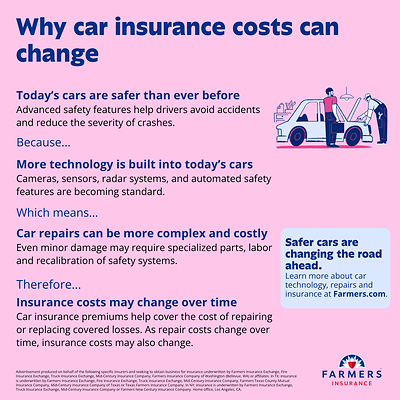
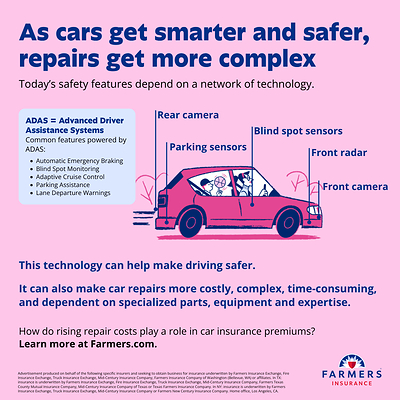
These features are part of what's known as Advanced Driver Assistance Systems, or ADAS. When a car with ADAS is damaged, repairs may require special parts, computer checks and careful adjustments to keep safety features working properly.
"Many drivers use these safety features every day, but they may not connect them to the cost of repairing a car after an accident," said Michaela Rush, Head of National Auto Physical Damage at Farmers®. "Features designed to help prevent collisions can also make repairs more complicated and costly. Understanding that connection can help consumers make informed decisions about their car insurance coverage."
ADAS is the safety technology behind many driver alerts and cameras
ADAS can include several safety features drivers may already use or recognize, such as:
- Front and rear cameras
- Automatic emergency braking
- Blind spot monitoring
- Parking sensors
- Adaptive cruise control
- Alerts when a driver drifts out of their lane
- Front radar systems
Federal rules are making some ADAS safety features standard in new cars
Many of these features are becoming standard across the car industry.
In fact, federal requirements already mandate rear visibility technology, including rearview cameras, on new cars1. In addition, the National Highway Traffic Safety Administration (NHTSA) has finalized a rule requiring Automatic Emergency Braking (AEB) to be standard on all new passenger vehicles by September 20292.
These safety-focused requirements reflect a broader shift toward vehicle technology designed to help reduce crashes and protect drivers, passengers and others on the road. While many factors influence roadway safety, U.S. traffic fatalities have declined for three consecutive years according to NHTSA3. Still, nearly 40,000 people die and more than 2.4 million are injured in vehicle crashes each year3, underscoring the continued need for safe driving behaviors and distraction-free driving.
As cars get safer, some repairs can become more expensive
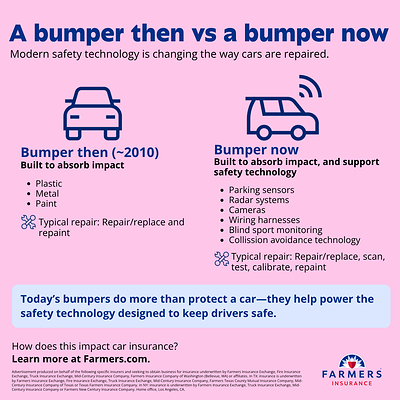
Repair costs can rise for many reasons, and advanced safety technology is just one factor that can make certain repairs more complex. In the past, a damaged bumper or windshield often involved a relatively straightforward repair.
Today, many vehicle components contain cameras, sensors and radar systems that help power safety features such as automatic emergency braking, blind spot monitoring and lane departure warnings.
As a result, repairs may involve more than replacing damaged parts. They can also include:
- Replacing technology components
- Diagnostic scans before and after repairs
- Testing vehicle safety systems
- Calibrating cameras, sensors or radar equipment
- Additional labor and specialized equipment
According to the Society of Automotive Engineers (SAE), a standards development organization serving the mobility industry, calibration helps ensure cameras, sensors and radar systems continue working correctly after repairs or component replacement4.
Because today's vehicles often contain more safety technology than they did just a few years ago, repairs can be more complex and may require additional time, expertise and equipment.
Even common repairs may require extra technology checks
Depending on the vehicle and damage, repairs involving safety features may require extra checks, calibration or specialized work to help keep those systems functioning as intended.
Repair scenario | Why it can add cost |
Windshield replacement | May require camera transfer, diagnostic scans and calibration |
Front-end repair | May affect radar, cameras or sensors used for automatic emergency braking and adaptive cruise control |
Rear bumper repair | May involve parking sensors, rear cameras or cross-traffic alert systems |
Side mirror repair | May involve cameras or sensors used for blind spot monitoring |
Parking sensor repair | May require sensor replacement, testing or calibration |
Rising repair costs may play a role in car insurance premiums
In many cases, consumers are paying to insure vehicles with more advanced safety technology than ever before — technology that can help protect drivers and passengers, but may also cost more to repair or replace after a covered loss.
Car insurance premiums are designed to help cover the cost of repairing or replacing covered losses. As the cost of parts, labor and repairs changes over time, insurance costs may also change.
"Today's vehicles offer incredible safety benefits, and that's a positive development for drivers," said Greg Ritter, Head of Auto Product at Farmers. "At the same time, it's important for consumers to understand that more technology often means more complex repairs. Having the right insurance coverage in place can help provide support when the unexpected happens."
Drivers can take proactive steps to plan for more complex repairs
- Review insurance coverage regularly. An insurance agent can help determine whether coverage still matches a vehicle's current value and technology.
- Consider deductible options carefully. Choosing the right deductible can help balance monthly premium costs and out-of-pocket expenses after a claim.
- Practice safe driving habits. Drivers can use telematics apps, like the Signal® by Farmers® app to better understand driving behaviors and encourage safer driving habits.
- Talk with an agent about potential car insurance savings. Because discounts vary, drivers may want to review their policy with an insurance agent to understand what savings opportunities may be available based on their car, coverage choices and driving habits.
Helpful tips after a claim
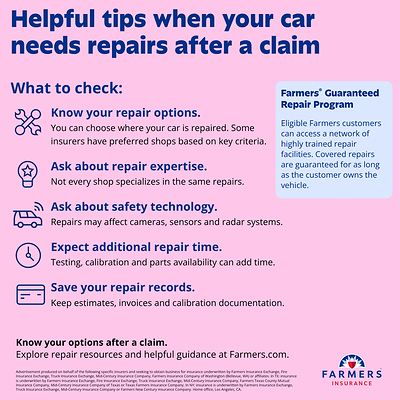
- Understand repair shop options. Some insurers may offer customers a list of reputable repair facilities they frequently work with. For example, Farmers offers a Guaranteed Repair Program, giving eligible customers access to a network of highly trained repair facilities and guaranteeing covered repairs for as long as the customer owns the vehicle. However, customers always have the choice of where to have their vehicle repaired.
- Ask whether the repair shop has the right expertise. Not all shops handle the same types of repairs. Some specialize in certain vehicles, systems or repairs, while others may need to transfer the vehicle to another facility for specific work.
- Ask whether safety technology may be affected. Cameras, sensors and radar systems can be built into windshields, bumpers, mirrors and other common repair areas.
- Plan for possible added repair time. Safety features can help protect drivers and passengers, but repairs involving these systems may take longer due to diagnostic scans, calibration, parts availability or specialized labor.
- Keep repair documentation. Customers may want to save estimates, invoices and repair records, including any notes about diagnostics, calibration or safety system testing.
Drivers can learn more at Farmers.com or from a local agent
Drivers interested in learning more about ADAS technology, common repair scenarios and car insurance considerations can visit the Farmers.com resource, How New Car Technology Is Changing Repairs and Car Insurance, or connect with a local Farmers agent.
Sources: |
1 U.S Department of Transportation, NHTSA Announces Final Rule Requiring Rear Visibility Technology https://www.transportation.gov/briefing-room/nhtsa-announces-final-rule-requiring-rear-visibility-technology |
2National Highway Traffic Safety Administration (NHTSA), NHTSA Finalizes Key Safety Rule to Reduce Crashes and Save Lives, https://www.nhtsa.gov/press-releases/nhtsa-fmvss-127-automatic-emergency-braking-reduce-crashes |
3 National Highway Traffic Safety Administration (NHTSA), Early Estimate of Motor Vehicle Traffic Fatalities and Fatality Rate in 2025, https://crashstats.nhtsa.dot.gov/Api/Public/ViewPublication/813800 |
4 SAE, J3338 - ADAS SENSOR CALIBRATION UNIFORM REPORT, https://www.sae.org/standards/j3338-adas-sensor-calibration-uniform-report |
About Farmers Insurance
"Farmers Insurance®" and "Farmers®" are tradenames for a group of insurers providing insurance for automobiles, homes and small businesses and a wide range of other insurance and financial services products. Farmers Insurance Exchange, the largest of the three primary insurers that make up Farmers Insurance, is recognized as one of the largest U.S. businesses on the 2026 Fortune 500 list. For more information about Farmers Insurance, visit Farmers.com.
Advertisement produced on behalf of the following specific insurers and seeking to obtain business for insurance underwritten by Farmers Insurance Exchange, Fire Insurance Exchange, Truck Insurance Exchange, Mid-Century Insurance Company, Farmers Insurance Company of Washington (Bellevue, WA) or affiliates. In TX: insurance is underwritten by Farmers Insurance Exchange, Fire Insurance Exchange, Truck Insurance Exchange, Mid-Century Insurance Company, Farmers Texas County Mutual Insurance Company, Mid-Century Insurance Company of Texas or Texas Farmers Insurance Company. In NY: insurance is underwritten by Farmers Insurance Exchange, Truck Insurance Exchange, Mid-Century Insurance Company or Farmers New Century Insurance Company. Home office, Los Angeles, CA.
Contact: | External Communications |
Farmers Insurance | |
818-965-0007 | |
 View original content to download multimedia:https://www.prnewswire.com/news-releases/safer-cars-smarter-repairs-farmers-insurance-explains-how-new-car-technology-may-impact-repair-and-insurance-costs-302863227.html
SOURCE Farmers Insurance


