U.S. Lumber Coalition Applauds Treasury Secretary Bessent For Stating the Facts Regarding Softwood Lumber
PR Newswire
WASHINGTON, Feb. 6, 2026
"BESSENT: Congress -- lumber...
WATERS: And have -- reclaiming my time. You don't get to talk.
BESSENT: Lumber [is] at a 5 year low congresswoman.
WATERS: Reclaiming my time.
BESSENT: Then let's just have the fact ma'am."
Source: BGov.com transcripts (Feb. 4, 2026).
WASHINGTON, Feb. 6, 2026 /PRNewswire/ -- Treasury Secretary Scott Bessent, during a recent Congressional hearing, stated the simple facts regarding softwood lumber prices: Softwood lumber prices are at historical lows and are driven by supply and demand factors. Softwood lumber prices are not driven by President Trump's focus on enforcing U.S. trade laws and implementing additional tariff measures to increase the softwood lumber production capacity of the United States.
"The U.S. Lumber Coalition applauds Secretary Bessent for stating the facts regarding softwood lumber prices," stated Zoltan van Heyningen, Executive Director of the U.S. Lumber Coalition. "Lumber prices have remained at historically low levels since August when higher duties and later tariffs went into effect."
"It is unfortunate that the misleading campaign by the National Association of Home Builders and Canada attacking President Trump's focus on strict U.S. trade law enforcement and tariff measures, which are designed to help the United States become self-sufficient in its lumber needs, continues to be echoed by others," added van Heyningen. (See: https://uslumbercoalition.org/resource/too-big-for-its-own-good-why-canadas-softwood-lumber-industry-needs-to-shrink/)
Here are the simple facts regarding the impact of Section 232 tariffs as well as the enforcement of U.S. trade laws, which have resulted in significant antidumping and countervailing duties against unfairly traded Canadian lumber imports:
- Softwood lumber prices have been lower, not higher, since the imposition of higher duties and President Trump's 10 percent tariff on lumber. Supply and demand, not trade law enforcement against unfairly traded lumber imports or targeted tariff measures, determine lumber prices.
- Canada continues to engage in well known and documented unfair and harmful trade practices against hundreds of thousands of U.S. workers, thousands of forestry-dependent U.S. communities, millions of private U.S. landowners, and hundreds of U.S. lumber companies who provide more than 75 percent and climbing of the softwood lumber needed to build U.S. homes. (See: https://uslumbercoalition.org/video/building-american-dreams/)
- U.S. lumber production capacity has increased by over 8 billion board feet since 2016 when duties and later tariffs went into effect, with U.S. producers supplying over 36 billion additional board feet of American-made lumber to build American homes. (See: https://uslumbercoalition.org/video/u-s-lumber-mills-discuss-increasing-production-in-reaction-to-president-trumps-latest-action-against-canadas-unfair-trade/)
- Canadian softwood lumber companies pay virtually all of the duties and tariffs, not U.S. consumers.
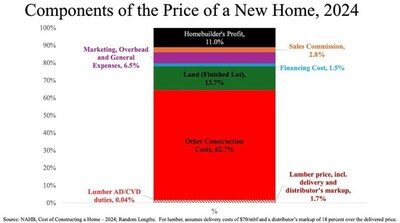
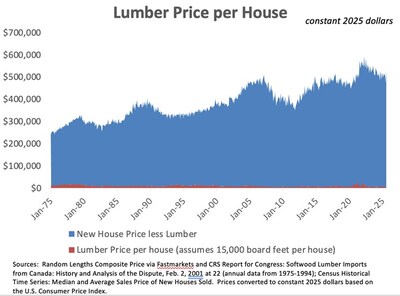
- The cost of lumber makes up less than 2 percent of the total cost of a new home, and hence never has and never will be a factor in housing affordability.
- Lumber prices have been so depressed that home builder companies have boasted in their earnings calls that they will try to use those low prices to their advantage when negotiating deals for the coming year. (See: https://uslumbercoalition.org/resource/high-homebuilder-profits-have-priced-millions-out-of-the-u-s-housing-market/)
- Attacks by the NAHB and Canada on trade law enforcement and common sense policy such as the targeted 10 percent lumber tariff are an attack on U.S. workers, U.S. companies, and their communities. (See: https://uslumbercoalition.org/video/u-s-lumber-trade-law-enforcement-is-working/)
Some other facts to keep in mind regarding the softwood lumber duties and tariff measures:
Who pays duties and tariffs on Canadian softwood lumber imports to the U.S. Treasury and U.S. taxpayers? (Note: Approximately 93 percent of duty deposits paid through 2023, i.e., $5.8 billion, is slated to be liquidated into the U.S. Treasury.)
Here is what Canadian companies say:
West Fraser Timber Co. Ltd.
- Total deposits paid through Q3 2025: USD $971 million
- Link: https://www.westfraser.com/sites/default/files/2025-10/West%20Fraser%20-%20Q3-25%20Combined%20Filing%20Document.pdf
- "As of September 26, 2025, our export duties paid and payable on deposit with the USDOC were $971 million" (pdf p. 56)
Canfor Corporation
- Total deposits paid through Q3 2025: USD $854 million
- Link:
https://cdn.sanity.io/files/9439mo3u/production/554e4ae6743872dfea006323896b193ce6113624.pdf
Domtar Corporation
- Total deposits paid through Q3 2025: USD $701 million
- Link:
https://www.sec.gov/ix?doc=/Archives/edgar/data/0001381531/000119312525258240/ck0001381531-20250930.htm - "As of September 30, 2025, a total of $701 million of cash deposits ($504 million of countervailing and $197 million of anti-dumping duties) on estimated softwood lumber duties were paid." (p. 35)
Interfor Corporation
- Total deposits paid through Q3 2025: USD $639.8 million
- Link: https://interfor.com/wp-content/uploads/2025/11/Q3-2025.pdf
- "Interfor has paid cumulative duties of US$639.8 million. . . as at September 30, 2025." (pdf p. 3)
Western Forest Products Inc.
- Total deposits paid through Q3 2025: USD $201 million
- Link: https://www.westernforest.com/wp-content/uploads/2025/11/NR-Results-2025-Q3-Website-Quarterly-Report.pdf
- "As at September 30, 2025, the Company had paid USD$201 million . . . of duties, all of which remain held in trust by US Department of Treasury." (pdf p. 26)
Conifex Timber Inc.
- Total deposits paid through Q3 2025: USD $78 million
- Link: https://conifex.com/wp-content/uploads/2025/09/Q3-2025-Conifex-Timber-FS-Notes-FINAL.pdf
- "Cumulative duties of US$44.1 million paid by the Company, net of sales of the right to refunds, since the inception of the current trade dispute, remain held in trust by the US pending the administrative reviews and conclusion of all appeals of US decisions." (pdf p. 14)
GreenFirst Forest Products Inc.
- Total deposits paid through Q2 2025: USD $102.6 million
- Link: https://greenfirst.ca/wp-content/uploads/Financial-Statements-Q2-2025.pdf
How much does the cost of lumber impact the cost of an average new home for U.S. consumers? And how does it compare to the profitability margins of U.S. homebuilders?
What has happened to U.S. lumber prices since duties increased from 14.50 percent to a combined average duty and tariff rate of 45.16 percent?
- Lumber prices have remained at historically low levels since early August 2025, when the increased duties took effect, and since October 2025, when the tariff took effect.
Who supplies the most lumber for U.S. homebuilding?
- U.S. softwood lumber workers and producers supply over 75 percent and climbing of the lumber needed to build U.S. homes.
- U.S. trade law enforcement and tariffs on softwood lumber not only safeguard this vital supply of lumber for our economy, but have helped add over 8 billion board feet of U.S. lumber production capacity since 2016, supplying a cumulative 36 billion board feet of additional U.S.-made lumber to build U.S. homes.
Have U.S. duties and tariffs increased jobs in the U.S. forestry sector since 2016?
- Yes, an estimated 14,000 direct and indirect jobs have been created in the United States by the lumber manufacturing sector since 2016 and counting.
- Today, the industry supports an estimated 750,000 jobs in the United States, often in communities where the addition of 500 or 1,000 jobs makes the difference between life and death of a community.
Canadian provincial and federal government officials point to the need to protect Canadian jobs when announcing billions of dollars of additional subsidies aimed at neutralizing President Trump's U.S. trade law enforcement and additional tariff measures. What is the cost to the United States of these new and mounting Canadian lumber subsidies?
- U.S. jobs.
- U.S. lumber production capacity.
- U.S. self sufficiency in lumber supply.
"As we have stated on numerous occasions, the U.S. Lumber Coalition applauds President Trump's focus on fully and effectively enforcing the U.S. antidumping and countervailing duty laws. We also applaud the President for taking the additional appropriate steps of imposing a 10 percent tariff to go after the true cause of Canada's unfair trade practices – massive excess lumber capacity supported by massive and mounting government subsidies. We urge all lawmakers to support U.S. workers, their communities, and U.S. companies. If we fail them, the result will be a lack of lumber to build U.S. homes. And that will hurt America and make us fully dependent on foreign sources while eliminating yet another U.S. manufacturing sector," concluded van Heyningen.
About the U.S. Lumber Coalition
The U.S. Lumber Coalition is an alliance of large and small softwood lumber producers from around the country, joined by their employees and woodland owners, working to address Canada's unfair lumber trade practices. Our goal is to serve as the voice of the American lumber community and effectively address Canada's unfair softwood lumber trade practices. The Coalition supports the full enforcement of the U.S. trade laws to allow the U.S. industry to invest and grow to its natural size without being impaired by unfairly traded imports. Continued full enforcement of the U.S. trade laws will strengthen domestic supply lines by maximizing long-term domestic production and lumber availability produced by U.S. workers to build U.S. homes. For more information, please visit the Coalition's website at www.uslumbercoalition.org.
CONTACT: Zoltan van Heyningen
zoltan@uslumbercoalition.org | 202-805-9133

 View original content to download multimedia:https://www.prnewswire.com/news-releases/us-lumber-coalition-applauds-treasury-secretary-bessent-for-stating-the-facts-regarding-softwood-lumber-302681549.html
SOURCE The U.S. Lumber Coalition


