Women Are Done With One-Note Pleasure -- In Fiction and In Bed.Fizz Was Built for That Shift.
PR Newswire
SINGAPORE, July 20, 2026
SINGAPORE, July 20, 2026 /PRNewswire/ --
The Pink Door
Last Saturday, women queued from 7:30am outside a bright pink door in Oxford. They traveled from Warrington, or flew from Norway, arrived with empty suitcases. The door belongs to Bad Girl Books — the UK's first shop dedicated entirely to romantasy, the genre blending fantasy with explicit romance. Shelves labelled "Monster Smut" and "Unhinged." Sarah J. Maas has sold 75 million books in this category. Founder Starlin Marot sold out within hours.
"It's a safe space to explore relationships and female pleasure from a woman's perspective," Marot told the Guardian. "I think that's really empowering."
The queue represents something larger than one bookshop's opening weekend. It points to a broader cultural shift: women are increasingly asking for desire to be treated as layered, specific, and self-directed— not reduced to the male gaze, a single trope, or a single sensation. The fantasy isn't escapism. It represents a form of liberation: the right to seek out multiple kinds of pleasure and to say so out loud.
An Ecosystem Built for Varied Desire
The appetite for variety visible in romantasy is also reshaping how pleasure is explored in everyday life. Once a discreet niche, sexual wellness has become a major consumer category, with the US sex-toy market valued at $10.62 billion in 2024 and expected to keep growing through 2030.
Clitoral suction is one of the clearest examples. What began as an alternative to vibration has become a category of its own, revealing demand for distinctly different sensations — and raising a new question: if pleasure need not be limited to vibration, why should it be limited to suction?
That demand has opened the door for technology companies to broaden how pleasure can be experienced. Standing out among them is Lovense, a company that describes its approach as "connected pleasure."
Lovense, a intimacy tech brand with millions of users worldwide, has taken that demand seriously enough to build an entire technology ecosystem around women's varied emotional, imaginative, and sensual desires.
Their app platform lets users program custom vibration patterns, hand real-time control to a partner from anywhere in the world, sync sensation to music, or let the body become immersed in the rhythms of an audiobook or short-form drama.The architecture carries the emphasis on variety and self-direction found in romantasy from narrative into physical sensation, treating pleasure as something personal, varied, and worth exploring on your own terms.
Pleasure is Not One-Note
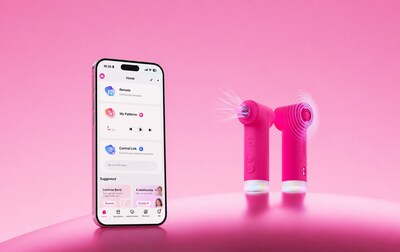
This month, they released Fizz — and its hardware alone makes the philosophy physical. Fizz is a dual-head clitoral stimulator: one end delivers air-pulse suction to the clitoral glans; the other produces rhythmic tapping across surrounding tissue. Two fundamentally different sensation types, independently controllable, app-programmable.
Most clitoral suction devices on the market operate on a single-point-of-contact philosophy — one nozzle, one spot, one script. Fizz splits the script in two and connects both heads to the full Lovense ecosystem, meaning the same device can produce radically different experiences depending on how you configure it.
"The industry has spent a decade optimizing one type of sensation," said Dan Liu, CEO of Lovense. "We think that's selling women short. Fizz exists because we believe pleasure should have the same complexity that women already bring to every other part
The Map That Took 28 Extra Years
New anatomical research adds context to that instinct. In March 2026, neuroscientist Ju Young Lee at Amsterdam University Medical Center published the first complete 3D map of the clitoral nerve network — revealing that the organ's primary sensory pathways don't terminate at the visible glans but branch at full strength into the hood, mons pubis, and labia.
The equivalent mapping for the penis was completed in 1998. Twenty-eight years earlier.
For product design, the implication is suggestive: the nerves involved in female pleasure extend across much of the vulva, indicating that broader and more varied forms of stimulation may better reflect the range of sensations many women experience. Suction focused solely on the tip of the clitoris can be highly effective, but it represents only one possible mode of stimulation.
She Deserves it
Helen O'Connell, Australia's first female urological surgeon, once observed that the medical community had "deleted [the clitoris] intellectually... presumably aligning attitude to a societal ignorance." Gray's Anatomy called it "a small version of the penis" as recently as 1995. The crowds at Bad Girl Books point to a growing appetite for narratives that treat female desire with greater depth, specificity, and respect.
Their fantasies — imaginative, physical, sexual — are not shameful and not simple. They deserve the same diversity in sensation that they now demand in narrative: a bookshop with twenty subgenres of desire, an openly accessible map of pleasure that dismantles old biases, and technology designed to reflect that complexity.
Fizz was created in that spirit — to give women more ways to shape, explore, and experience what feels good to them. Whether pleasure begins in fantasy or is felt through the body, women deserve more than one script, one sensation, or one way to feel. The right to plural pleasure is not a luxury. It is, at minimum, what was always owed.
About Lovense
Lovense is a global sex tech brand specialising in app-controlled intimacy devices. Fizz is available globally from July 20, 2026, at lovense.com. Retail price: $129 USD.
 View original content to download multimedia:https://www.prnewswire.com/news-releases/women-are-done-with-one-note-pleasure--in-fiction-and-in-bedfizz-was-built-for-that-shift-302824731.html
SOURCE Lovense


